
Using Neurofeedback to Improve Focus in ADHD
A Natural Way to Improve Attention:
If you or someone you care about has ADHD, you already know that staying focused isn’t just about trying harder.
Distractions, mental fatigue, and difficulty finishing tasks can feel like a constant battle. These challenges often come from how the brain regulates attention, not from a lack of effort.
That’s why more people are exploring neurofeedback for ADHD focus as a natural, drug-free way to improve attention and support better brain function.
Why Focus Is Difficult in ADHD:
ADHD affects how the brain manages attention, impulse control, and mental clarity.
Instead of smoothly shifting between tasks or staying engaged, the brain may:
Drift easily toward distractions
Struggle to sustain attention
Feel either overstimulated or underactive
Have trouble organizing thoughts
This is where neurofeedback for ADHD focus offers a different approach by working directly with brain activity rather than just symptoms.
ADHD Focus improves with Neurofeedback:
The brain operates using electrical patterns called brainwaves. In individuals with ADHD, these patterns may be out of balance.
For example:
Too much slow-wave activity can lead to inattention
Too much fast-wave activity can cause restlessness
Neurofeedback for ADHD focus helps regulate these patterns by reinforcing healthier brain activity.
Over time, this can lead to:
Better sustained attention
Reduced impulsivity
Improved mental clarity
Greater task completion
Medication-Free Option:
One of the biggest reasons people choose neurofeedback for ADHD focus is that it does not rely on medication.
While medication can be helpful for some, others prefer a more natural approach or want to complement existing treatments.
Neurofeedback is:
Non-invasive
Drug-free
Customized to individual brain patterns
Focused on long-term improvement
This makes it an appealing option for both children and adults.
What to Expect During Neurofeedback Training:
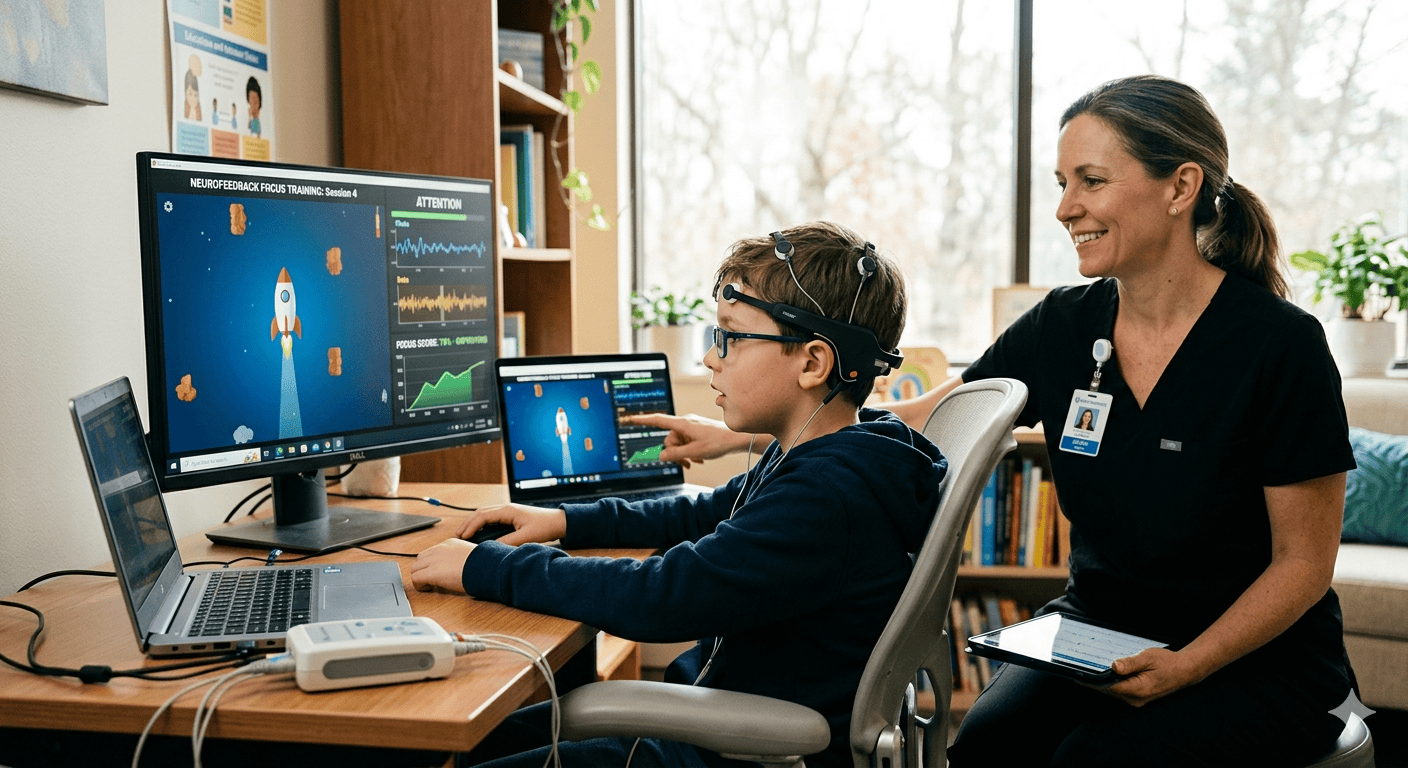
A typical neurofeedback session is simple and comfortable. Sensors are placed on the scalp to measure brain activity. Then, the individual watches a screen or listens to audio that responds to their brain patterns. When the brain moves toward better focus, it receives positive feedback.
Over multiple sessions, the brain gradually learns to maintain these improved patterns on its own.With consistent training, neurofeedback for ADHD focus can create lasting changes in how the brain functions.
Why More People Are Choosing Neurofeedback:
As awareness grows, more individuals are turning to brain-based solutions rather than symptom-based approaches.
Neurofeedback for ADHD focus stands out because it:
Addresses the root cause (brain function)
Encourages long-term improvement
Supports overall cognitive health
Fits into a holistic wellness approach
Final Thoughts:
Improving focus with ADHD doesn’t have to rely on willpower alone. By training the brain to function more efficiently, neurofeedback for ADHD focus offers a practical and natural way to enhance attention, reduce distractions, and support daily performance.
For those seeking a non-invasive, long-term solution, neurofeedback remains a promising path to better focus and mental clarity.

About the Author
“Melissa Hergert is the Founder and CEO of Brain Train Centers and CoFounder of Brain Train Nation. She is Board Certified in Neurofeedback Therapy and Amen Clinic Brain Coach Certified.
She is dedicated to educating communities about the power of neurofeedback and how it can help the brain heal and overcome many mental health symptoms.”
